Do you remember what a cup of coffee cost ten years ago?
If you feel like your paycheck vanishes faster than it used to, you aren’t imagining things. While most of us focus on the numbers in our bank account to gauge our wealth, there is an invisible force constantly working against us.
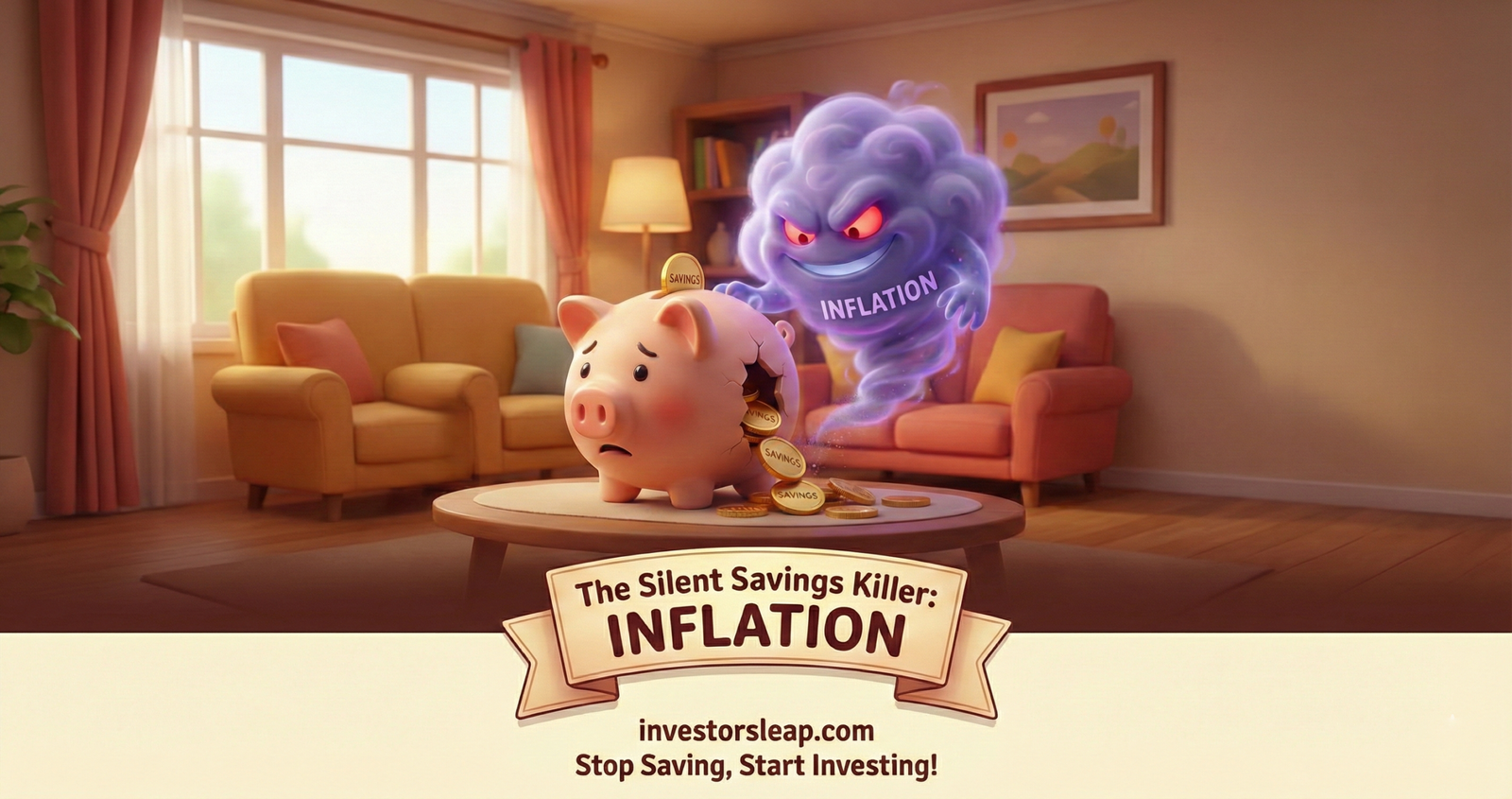
That force is Inflation, and it is arguably the single biggest threat to your long-term financial health.
The Invisible Tax
Most people view “saving money” as the ultimate safe financial move. We are taught to stash cash away for a rainy day. While having an emergency fund is vital, keeping all your wealth in a standard checking or savings account is actually a guaranteed way to lose money.
How? Because of the erosion of Purchasing Power.
Inflation is the rate at which the general level of prices for goods and services is rising. If inflation is at 3%, a loaf of bread that costs $1.00 today will cost $1.03 next year.
That doesn’t sound like much, right? But compound that over 10, 20, or 30 years, and the results are devastating.
The Math of Losing Money Safely
Let’s look at the numbers.
To understand if your money is growing, you cannot just look at the Nominal Interest Rate (what the bank pays you). You must look at the Real Rate of Return.
The formula is approximately:
Real Return≈Nominal Interest Rate−Inflation Rate
The Scenario:
- You have $10,000 in a traditional savings account.
- The bank pays you 0.5% interest per year.
- The annual inflation rate is 3.0%.
The Result:
0.5%−3.0%=−2.5%
You aren’t making 0.5%; you are effectively losing 2.5% of your wealth every single year. You still see $10,000 (plus a tiny bit of interest) on your screen, but that money buys significantly less than it did the year before.
Breaking the Cycle: How to Leap Ahead
If cash is a losing bet, what is the solution? You must invest in assets that historically outpace inflation.
To preserve and grow your wealth, your money needs to be “employed.” Here are three common vehicles used to beat the silent killer:
- The Stock Market: Historically, the S&P 500 has returned an average of about 10% annually before inflation. Even after adjusting for inflation, the real return is significantly positive.
- Real Estate: Property values and rental income tend to rise with inflation, making real estate a popular “hedge.”
- High-Yield Savings Accounts (HYSA): At the very least, move your emergency fund to a High-Yield Savings Account. While it may not beat inflation entirely, it will significantly narrow the gap compared to a standard checking account.
🚀 The Investors Leap Tip
Don’t Let “Lazy Money” drag you down.
At Investors Leap, we believe in the concept of Velocity of Money. Money that sits still dies a slow death.
The Tip: Calculate your “Core Number” the exact amount you need for 6 months of emergency expenses. Keep that liquid in a High-Yield Savings Account. Every single dollar above that number must be given a job. Whether it’s buying an index fund, funding a Roth IRA, or saving for a down payment, give every dollar a mission. If it’s not working for you, it’s working for inflation.
The Bottom Line
Inflation doesn’t care about your savings goals. It is relentless, quiet, and consistent. The only defense is offense. By moving your mindset from “saving” to “investing,” you stop being a victim of the economy and start being a participant in its growth.
Stop saving. Start investing. Make the leap.