The world of investing can feel like a high-stakes casino reserved for Wall Street elites. Between the confusing jargon, endless stock tickers, and fear of losing money, it’s understandable why so many people freeze before they even start.
At Investors Leap, we believe the fastest way to financial confidence is to simplify and demystify. Investing is not about getting rich overnight; it’s about setting up a few powerful, automated systems that work for you over the next few decades.
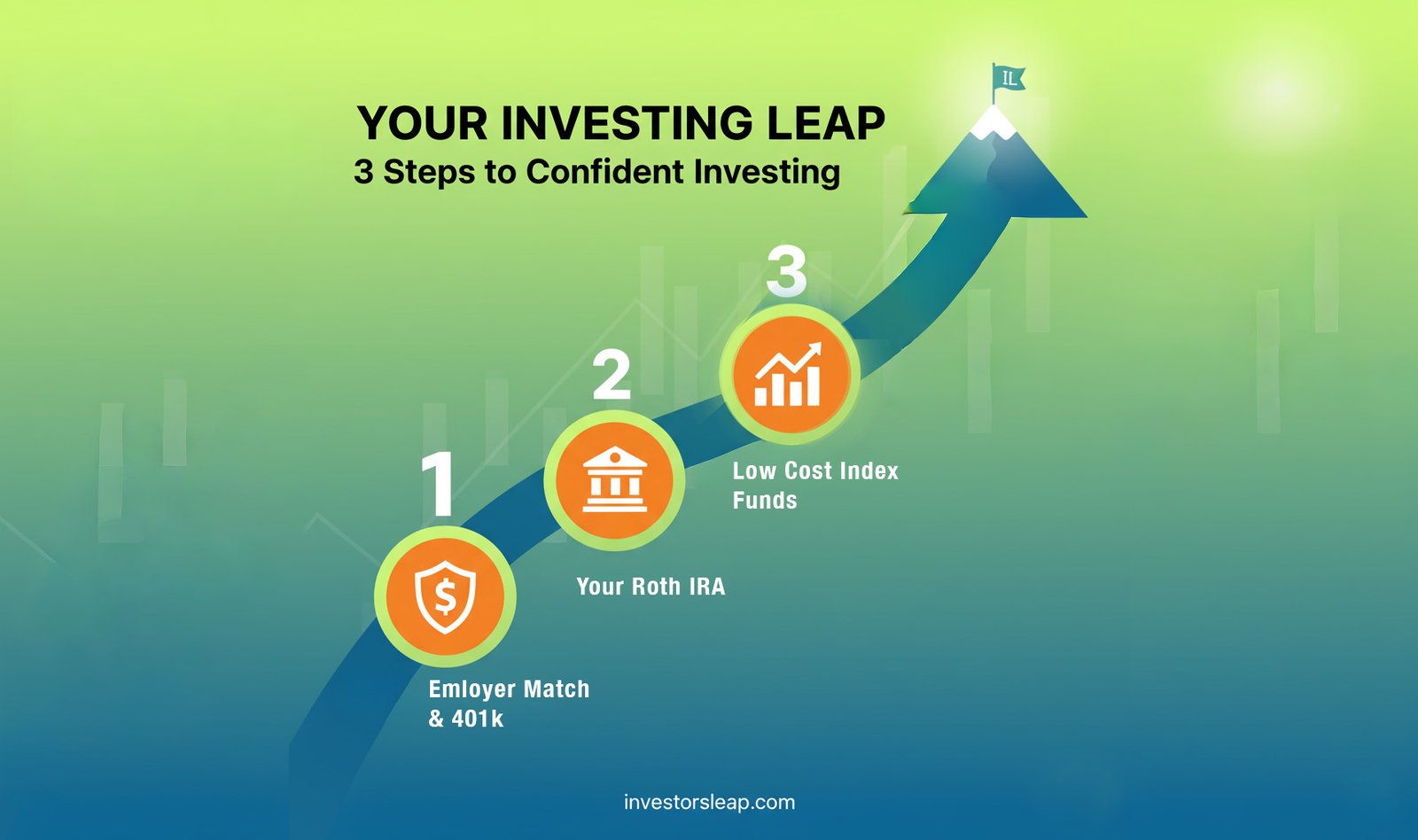
If you have your emergency fund locked down (which we covered in our Subscription Shredder post!), you are ready to take your first three concrete steps toward becoming an investor.
Step 1: Secure Your Retirement Wins (The Free Money Loop)
Before you buy a single stock, your first move is to claim any “free money” offered to you, typically through an employer-sponsored retirement plan.
The 401(k) Match (If Available)
If your employer offers a 401(k) plan and matches your contributions up to a certain percentage (e.g., they match 100% of the first 4% of your salary), you must contribute at least enough to get that full match.
Why this is Step 1: This is an instant, guaranteed 100% return on that portion of your investment. No market magic or genius required, it’s the highest return you will ever get. If you don’t contribute enough to get the full match, you are literally turning down free money.
Set and Forget
- Action: Contact your HR department today and enroll.
- The Leap: If you’re overwhelmed by fund choices, simply select a Target Date Fund (TDF) closest to your expected retirement year (e.g., 2065). These funds automatically adjust the risk as you age.
Step 2: Open Your Investment Launchpad (The Tax Advantage)
Once you’ve maximized your employer match, the next step is to open your own dedicated investment account, prioritizing tax advantages. These accounts are designed to make your money grow faster because the government gives you a tax break.
The Roth IRA (Roth Individual Retirement Arrangement)
For most beginners, the Roth IRA is the ideal starting point.
- How it Works: You pay taxes on the money now (when you contribute), and then all the money grows tax-free, and you withdraw it tax-free in retirement.
- The Power: Imagine paying $1,000 in taxes today to withdraw $100,000 completely tax-free later. That is the compounding magic of the Roth IRA.
How to Open It
- Choose a Brokerage: You need an investment company (brokerage) to hold your account. Popular, low-cost options include Fidelity, Vanguard, or Charles Schwab.
- Action: Open a Roth IRA account (it takes about 10 minutes online).
- The Leap: Commit to contributing a fixed, monthly amount via auto-transfer. Consistency is your biggest ally.
Step 3: Choose Your Simple Vehicle (The Low-Cost Engine)
Now that you have the where (your 401(k) and Roth IRA), you need the what—what should you actually invest in? You do not need to pick individual stocks to win.
The simplest, most powerful strategy is to rely on low-cost, diversified index funds.
Index Funds are the Answer
An Index Fund is a single basket that holds small pieces of hundreds, or even thousands, of different stocks, mimicking the performance of a major index like the S&P 500.
- Why They Win:
- Diversification: If one company fails, it barely affects your total portfolio. You are investing in the entire market, not just one company.
- Low Cost: Index funds have extremely low fees (called expense ratios) because they don’t require expensive human managers to pick stocks.
- Proven Performance: Historically, it’s incredibly difficult for even professional investors to consistently beat the market, meaning the simple, low-cost index fund often wins the long game.
Popular Beginner Investment Choices
In your Roth IRA, look for these types of funds (using common symbols as examples):
- US Stock Market Index: Funds that track the broad U.S. stock market (e.g., Vanguard’s VTSAX or Fidelity’s FZROX).
- Total World Stock Index: Funds that include both U.S. and International stocks for maximum global diversification.
🛑 What Not to Do in Investing 101
- Don’t check your portfolio daily: The market will go up and down. Compounding is a long-term strategy, and emotional decisions based on daily news are the fastest way to lose money.
- Don’t chase hot stocks: Avoid getting pulled into the latest hype stock or cryptocurrency if you don’t fully understand the risk. Stick to broad, diversified funds until you’ve gained experience.
- Don’t wait for the “perfect time”: The best day to invest was yesterday. The second-best day is today. Because of the power of compounding, time in the market beats trying to time the market.
Your financial future is built on habits, not heroics. By taking these three steps, securing your match, opening your Roth, and choosing a simple index fund, you have officially made the leap from saver to investor.
Now that you have your core Investing 101 content, what step would you like to focus on next? Perhaps an outline on how to choose a low-cost brokerage or a deep dive into how Index Funds work?