In the world of fixed-income investing, there is an eternal struggle between yield and liquidity.
If you want the highest interest rates (yield), you usually have to lock your money away for years. If you want easy access to your cash (liquidity), you usually have to settle for lower rates in a savings account.
But what if you didn’t have to choose?
Enter the CD Ladder. It is one of the most effective strategies for conservative investors to lock in competitive interest rates while ensuring cash becomes available at regular intervals. Here is how to build one and why it is the perfect strategy for the current rate environment.
What is a CD Ladder?
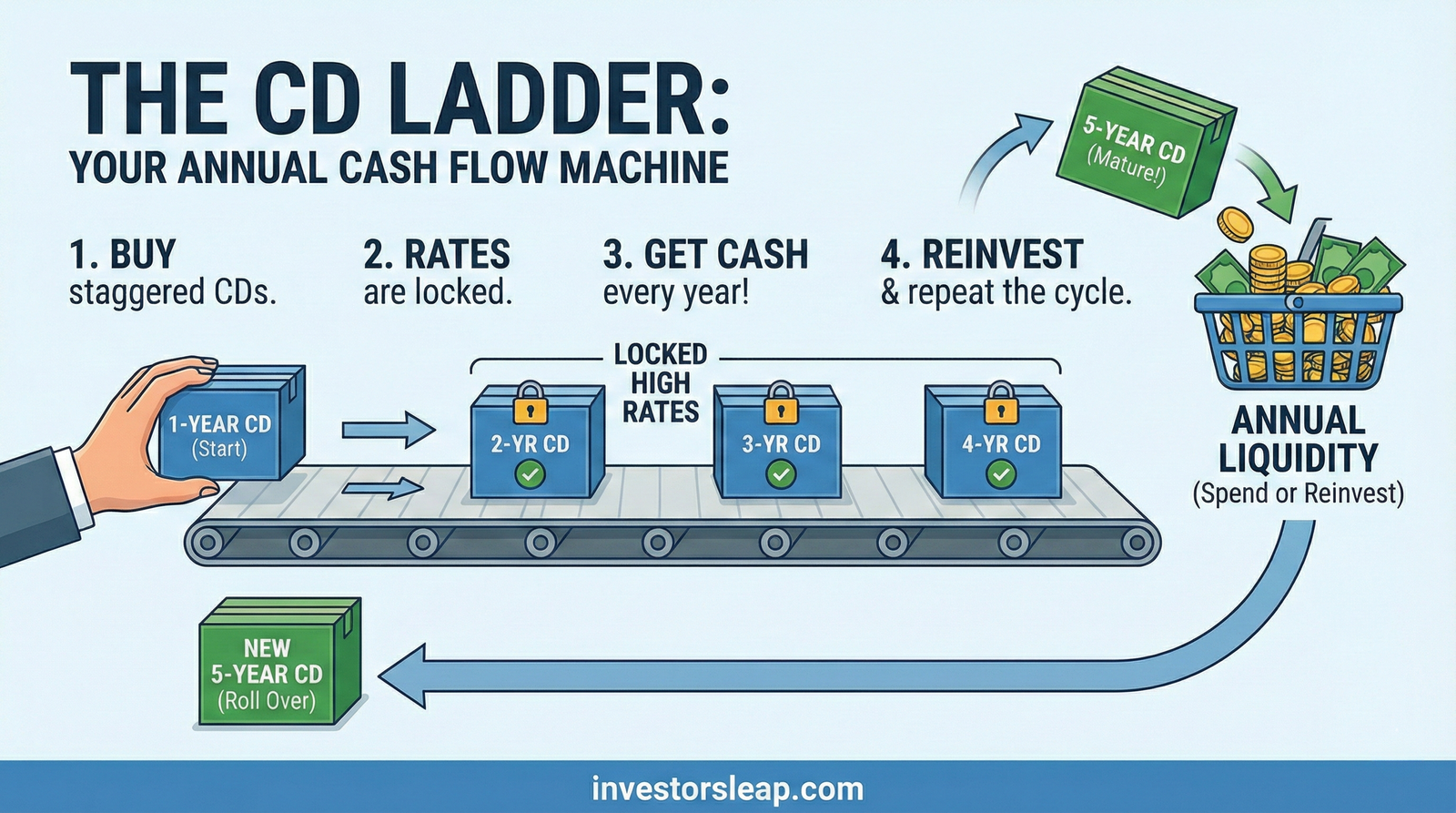
A Certificate of Deposit (CD) Ladder is a strategy where you divide a sum of money into equal amounts and invest them in CDs with different maturity dates.
Instead of putting all your cash into a single 5-year CD (which locks it all away) or a 6-month CD (which offers a lower return), you stagger the investments. This creates a “ladder” of maturity dates.
The Goal
The objective is to achieve a blended interest rate that is competitive with (or superior to) standard savings accounts over the long haul, while ensuring that a portion of your money “matures” (becomes available to you) on a regular schedule—usually every year.
How to Build Your First Ladder: A Practical Example
Let’s say you have $10,000 to invest. Instead of putting it all into one vehicle, you split it into five “rungs” of $2,000 each.
Here is how you would structure the initial buy:
| Rung | Investment Amount | Term Length | Status |
| Rung 1 | $2,000 | 1-Year CD | Matures in 12 Months |
| Rung 2 | $2,000 | 2-Year CD | Matures in 24 Months |
| Rung 3 | $2,000 | 3-Year CD | Matures in 36 Months |
| Rung 4 | $2,000 | 4-Year CD | Matures in 48 Months |
| Rung 5 | $2,000 | 5-Year CD | Matures in 60 Months |
The “Rolling” Strategy
The magic happens one year later.
- Year 1 ends: Your Rung 1 (1-Year CD) matures. You now have $2,000 cash plus interest.
- Reinvestment: Instead of putting it back into a 1-year CD, you roll it into a new 5-Year CD.
- Repeat: You repeat this process every year.
Eventually, you will own five distinct 5-Year CDs, but because you bought them at different times, one of them will mature every single year. You are earning the higher long-term 5-year rate on all your money, but you still have liquidity every 12 months.
The Comparison: High-Yield Savings vs. CD Ladder
Many investors ask: “Why not just leave it in a High-Yield Savings Account (HYSA)?”
The answer lies in Rate Risk. While HYSAs currently offer attractive rates, they are variable. If the Federal Reserve cuts rates, your savings yield drops immediately. A CD Ladder locks in your rate for years.
Here is a snapshot comparison based on competitive market rates available as of late 2025:
| Feature | High-Yield Savings Account (HYSA) | 5-Year CD Ladder (Blended) |
| Current APY (Est.) | ~4.50% – 5.00% | ~4.00% – 4.20% (Blended Avg) |
| Rate Type | Variable (Can drop tomorrow) | Fixed (Locked for term of CD) |
| Liquidity | Instant (Withdraw anytime) | Staggered (Part available yearly) |
| Best For | Emergency funds; Short-term cash | Long-term holdings; Income generation |
| Scenario: Rates Drop | Your yield decreases immediately. | Your yield stays high (locked in). |
| Scenario: Rates Rise | Your yield increases. | You capture higher rates as rungs mature. |
> Note: While the HYSA currently shows a higher “headline” rate, the CD Ladder wins on longevity. If savings rates drop to 2% next year, your CD Ladder will still be paying out ~4% on the majority of your funds.
Why This Strategy Wins: The “Lock-In” Effect
The primary reason investors turn to CD Ladders is to hedge against interest rate changes. It removes the need to predict the future.
Scenario A: Interest Rates Fall
If the Federal Reserve cuts rates, savings account yields drop immediately. However, with a ladder, the majority of your money is still locked in at the older, higher rates in your 3, 4, and 5-year CDs. You continue to earn high yields even as the market cools.
Scenario B: Interest Rates Rise
If rates skyrocket, you aren’t stuck holding a low-yield asset for five years. Because one of your CDs matures every year, you have cash available annually to reinvest at the new, higher rates. You can participate in the upside.
The Pros and Cons
Before building your ladder, weigh the trade-offs:
The Pros:
- Safety: CDs are typically FDIC-insured (up to limits), making them one of the safest investments available.
- Predictability: You know exactly how much interest you will earn and exactly when your cash will be available.
- No Market Volatility: Unlike bonds or bond funds, the principal value of a CD does not fluctuate with the stock market.
The Cons:
- Inflation Risk: If inflation rises higher than your interest rate, your real purchasing power could decrease.
- Penalty Risk: If you have an emergency and need to break a rung of the ladder before it matures, you will likely pay an early withdrawal penalty (often a few months of interest).
Summary
The CD Ladder is the “slow and steady” approach to wealth preservation. It provides a psychological benefit that is just as valuable as the financial one: Peace of mind. You stop worrying about timing the market, and you start profiting from a disciplined, automated system.
If you have cash sitting on the sidelines waiting for the “perfect time” to invest, the CD Ladder suggests that the perfect time is simply a staggered timeline.