
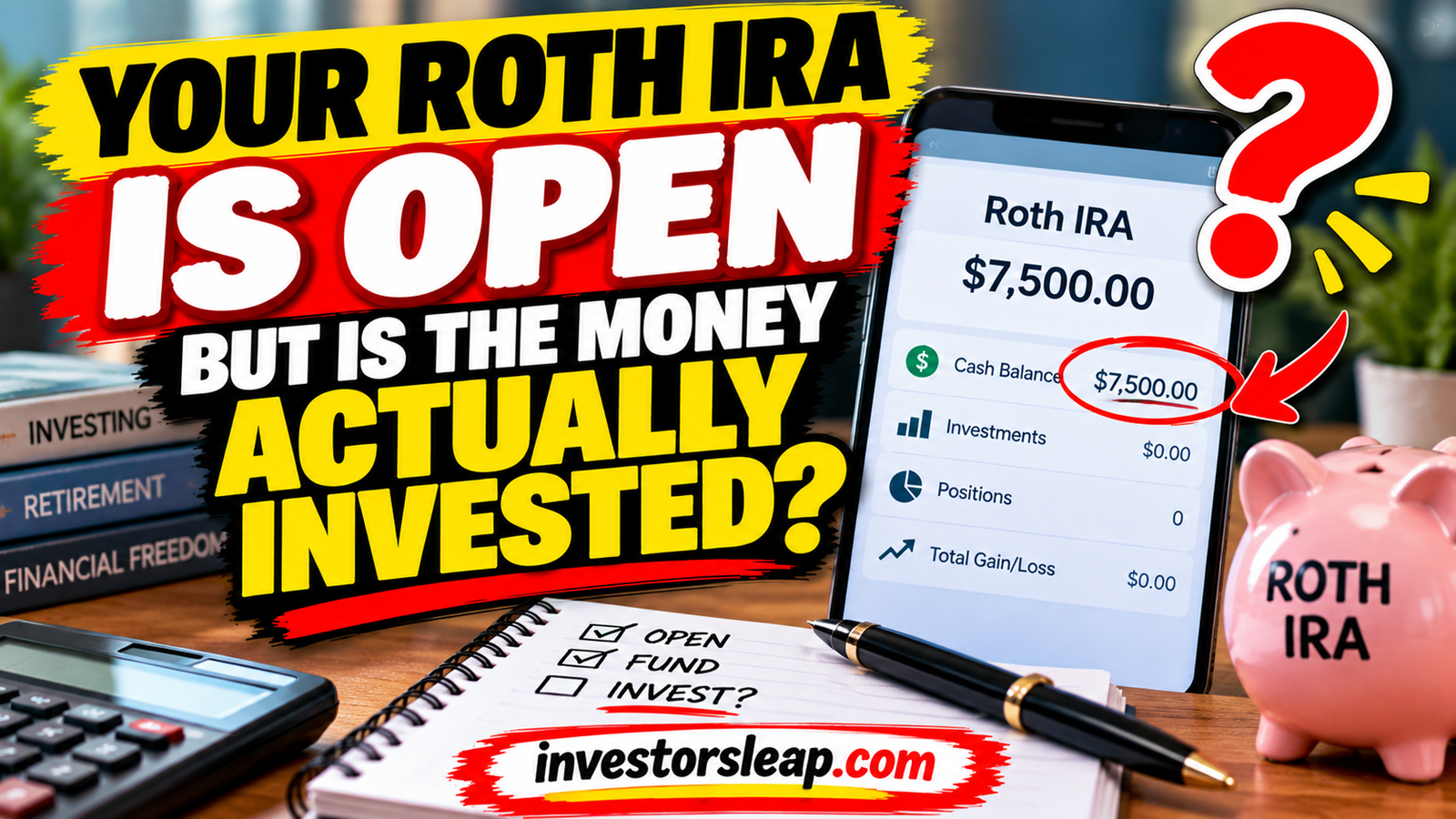
You opened a Roth IRA, transferred money, and checked the balance. Retirement saving: done. Or is there one more step?
Money arriving in an account does not necessarily mean it purchased the investments you intended. Depending on the provider and account setup, a contribution may remain in a cash or cash-equivalent position until investment instructions are in place. Fidelity highlights this overlooked IRA step and notes that some managed accounts handle investing according to the strategy selected.
This is not an instruction to rush into stocks. It is an invitation to answer a basic question: what does your account actually own, and is that what you meant it to own?
A Roth IRA is the account not one particular investment
The IRS describes the rules for Roth IRAs, including the fact that contributions are not deductible and qualified distributions can be tax-free. Those tax rules do not specify one investment that every account holder automatically receives.
Think of the account name as answering one question and the holdings as answering another. “Roth IRA” identifies the retirement account. A holdings list shows where its value currently sits.
The distinction matters because two accounts can each show a $3,000 total while holding completely different things. A growing account balance might also reflect new deposits rather than investment returns. The headline total alone cannot tell you whether your intended plan is in place.
Open the holdings page, not just the balance screen
Use the account’s official website or app. The relevant screen may be labeled holdings, positions, investments, or account details. Names and workflows vary, so ask the provider when a label is unclear rather than assuming another brokerage’s instructions will match yours.
Build a short account worksheet with these questions:
- What is listed? Write down the names of funds, securities, deposits, or cash positions.
- How much is in each? Compare dollar values and, where shown, their share of the account.
- What happened after the latest deposit? Look for a separate investment purchase, a pending order, or confirmation that the contribution was allocated by the service.
- What was supposed to happen? Compare the account with your own instructions, not a portfolio suggested by a social-media clip.
A label such as available to trade describes an account function; it does not by itself explain the underlying holding. Read the position details. A pending order is also different from a completed purchase, so check its status before entering a duplicate instruction.
Never share passwords, account numbers, or security codes to obtain an answer from someone contacting you through social media. Use your provider’s established support channel for account-specific questions.
Cash is not automatically a mistake
Some IRA cash positions earn interest, and a core position can be a money market fund. Technically, a money market fund is itself an investment: the SEC describes it as a mutual fund holding liquid, short-term instruments. It is not the same thing as a bank money market deposit account, and a money market fund is not FDIC-insured.
That distinction keeps this article’s question precise. We are checking whether the money is allocated as intended, not claiming that every cash-like holding earns nothing or is outside all investments.
For example, you might deliberately hold cash for a planned distribution, maintain a conservative allocation, or be waiting for an already-submitted transaction. Those circumstances differ from believing a stock-and-bond strategy is running when the account has never bought those holdings.
The useful test is intentional versus accidental. Can you explain what the position is for? Is the amount consistent with your goal? Do you understand its risks, costs, and protections? Our Cash Management & Brokerage resource is a place to continue learning about account and cash-management choices.
A hypothetical example: why the intended strategy matters
To isolate the mathematics, imagine $3,000 left for 20 years with no additional deposits or withdrawals. Compare two arbitrary, constant annual return assumptions, compounded annually.
| Assumed annual return | Calculated ending value |
|---|---|
| 3% | About $5,418 |
| 6% | About $9,621 |
The formula is $3,000 × (1 + annual return)20. The calculated difference is approximately $4,203. Neither rate is a current yield, a forecast, or a promised return from a particular investment. Fees, taxes, and inflation are excluded, and real returns will not follow a smooth line.
This example does not say you can safely double a return by clicking another button. It shows why your chosen assumptions and actual holdings should not be disconnected for years. An investment with greater growth potential can also lose value.
Use the free Compound Interest Calculator to explore different assumptions. Keep the compounding convention consistent when comparing results; a calculator using monthly compounding will not exactly reproduce an annually compounded example.
Choose the approach before choosing the ticker
Your time horizon, ability to tolerate losses, and overall finances should inform the investment mix. The SEC’s asset-allocation guide explains why these factors matter and why diversification is about spreading exposures rather than simply collecting more investment names.
Before researching an individual fund, write a plain-language description of its job. Is it intended to provide broad stock exposure, bond exposure, or short-term stability? How would it fit with your other accounts? A clear role makes it easier to recognize when an appealing product does not fit your plan.
Compare costs as well as holdings. The SEC’s introduction to mutual funds explains that funds have different risks and expenses, and that their names alone are not enough to understand what they own. Read the provider’s product information and ask questions before purchasing.
You do not have to turn an account check into a same-day purchase. Learning enough to make an informed decision, or discussing suitable choices with a qualified professional, is different from leaving a question unexamined indefinitely. Visit Investing 101 for the underlying concepts.
Contribution eligibility is a separate question
This account review is not a recommendation to make a new deposit. The IRS notes that Roth IRA contribution eligibility can depend on income and filing status, and that Roth and traditional IRAs share a combined contribution limit. Check the current rules and your circumstances before adding money.
Money already in the account still deserves a review even when a new contribution is not appropriate. Do not treat an investing tutorial as confirmation that you qualify to contribute, or confuse an investment purchase inside an account with instructions to withdraw money to your bank.
Withdrawals, conversions, and rollovers have their own rules. Check the IRS Roth IRA guidance and obtain account-specific or tax guidance before attempting one to fix what may simply be an allocation question.
Check the next contribution not just the current balance
A useful setup has a clear sequence: eligible money arrives, the intended investment instruction is in place, and the resulting transaction is confirmed. Do not assume enabling one part automatically enabled the others.
Write down the next transfer date, expected amount, intended destination, and where you will check its completion. After that scheduled activity occurs, review the account once to confirm it matched the plan. Investigate a rejected order, a missing purchase, or a larger-than-expected cash balance before repeating the process.
For an account managed by a provider, review its allocation policy and allow for the service’s documented processing schedule. The right question is whether it followed your selected strategy, not whether its screen resembles a self-directed account.
Your next step: explain your account in one sentence
Try completing this sentence: “My Roth IRA currently holds ___ because I intend to use this money for ___, and my next contribution will ___.”
An unanswered blank identifies a useful follow-up question. You may need to learn what a holding is, confirm an automation setting, or revisit the investment mix. You do not need to manufacture urgency or buy the investment mentioned in the latest video.
Opening the account is progress. Funding it is progress. Understanding what it holds—and confirming that it matches your intention—makes those steps part of a plan. Continue with the Retirement Planning resource or the Investors Leap Wealth Roadmap to connect this check with your broader goals.
Investors Leap provides financial education, not individualized investment or tax advice. Investing involves risk, including loss of principal. No investment, yield, or return assumption in this article is a recommendation or guarantee.