
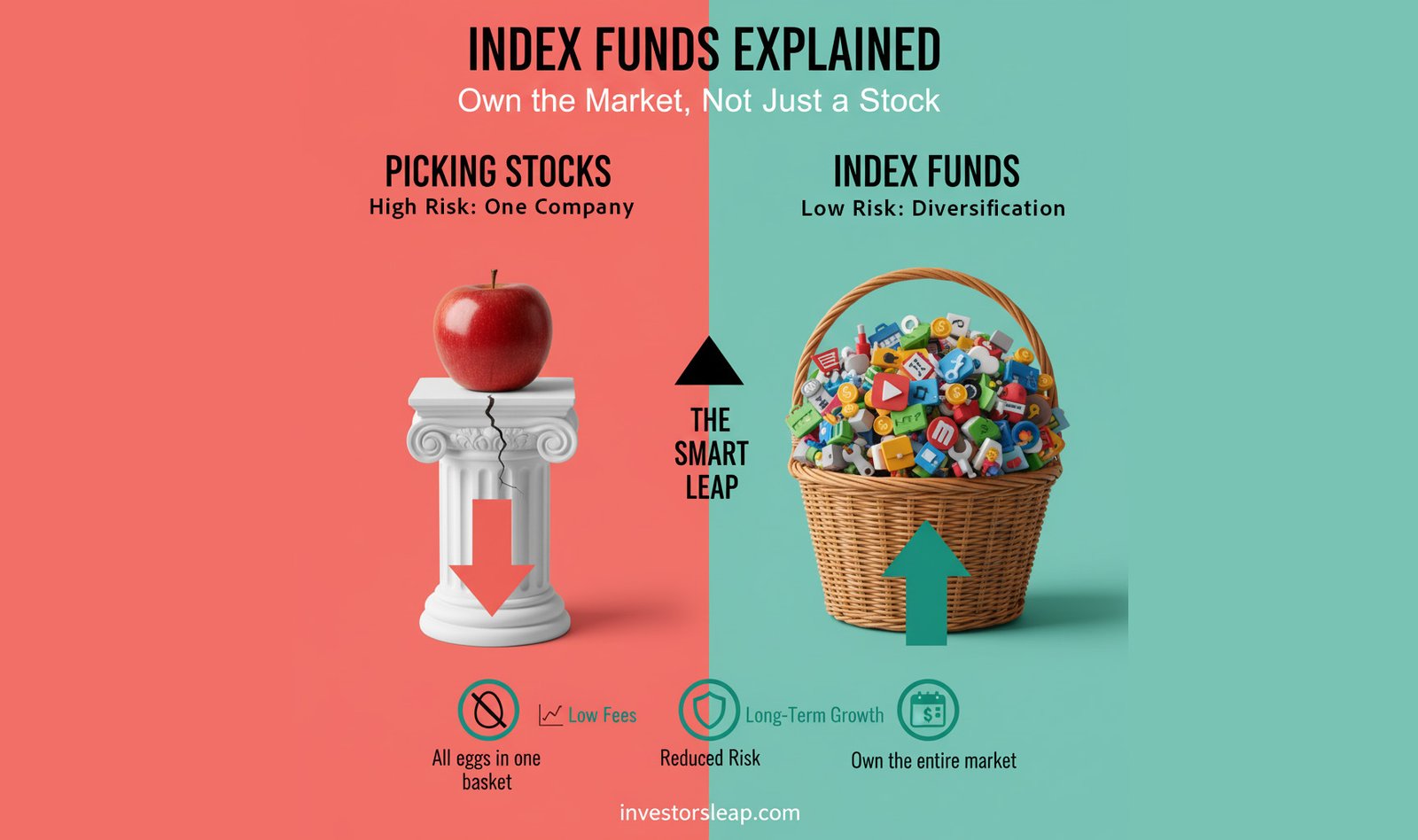
An index fund is a mutual fund or ETF designed to track a particular market index. This guide builds on Investing 101 by explaining what a fund actually holds, what it costs, and where diversification stops protecting you.
Related: Visit the Investing 101 hub for the full beginner pathway, and use the Investment Fee & Expense Ratio Calculator to see how fund costs can compound over time.
It’s time for a deep dive.
Think of the stock market as a vast ocean filled with thousands of different fish (individual stocks). Trying to pick the “best” fish at any given moment is incredibly difficult, even for seasoned professionals. Index funds offer a brilliant alternative: instead of trying to catch the fastest fish, they give you a net that catches a representative sample of all the fish.
This guide explains how index funds work and how to compare them against your goals, investment horizon, and ability to tolerate losses. One stock fund is not a complete plan for every goal.
🔍 What Is an Index Fund? (More Than Just a Basket)
At its core, an index fund is a type of mutual fund or Exchange Traded Fund (ETF) that holds a collection of stocks (or bonds) designed to mirror the performance of a specific market index.
What’s a Market Index?
A market index is simply a theoretical portfolio of stocks that represents a segment of the market. The most famous examples are:
- S&P 500: Tracks the performance of 500 of the largest U.S. companies (e.g., Apple, Microsoft, Amazon, Tesla).
- Dow Jones Industrial Average (DJIA): Tracks 30 large, publicly owned U.S. companies.
- Total Stock Market Index: Tracks thousands of U.S. companies, from the largest to the smallest.
- International Indices: Track companies outside the U.S. (e.g., MSCI EAFE).
An S&P 500 index fund seeks to track that index, using its holdings or a representative sample. Actual returns differ because of fees, trading costs, and tracking error. A fund can fall when its benchmark falls.
🌟 Benefits and Limits of Index Funds
Why do financial experts (including us at Investors Leap) rave about index funds for long-term wealth building?
1. Instant Diversification (The Ultimate Risk Reducer)
- Problem: If you buy stock in just one company, and that company goes bankrupt, you could lose everything.
- Diversification has limits: Holding many companies reduces dependence on one business, but market-wide losses remain possible. A market-weighted index can have substantial exposure to its largest companies; a sector index can be especially concentrated.
2. Lower Costs (More Money Stays in Your Pocket)
- Problem: Actively managed funds employ highly paid managers who try to pick winning stocks. Their salaries and trading activities lead to higher fees (expense ratios) for you.
- Solution: Index funds are “passively managed.” They simply buy and hold what’s in the index. This means far fewer analysts, less trading, and significantly lower fees. Over decades, even a 1% difference in fees can cost you tens of thousands of dollars in lost returns.
3. Benchmark Tracking, Not Guaranteed Outperformance
- Compare fairly: Compare a fund with an appropriate benchmark over the same period, including fees. Historical results do not establish which fund will perform best in the future.
- Tracking is the objective: Index funds aim to follow their benchmark, not beat it. Low costs may help investors retain more of a fund’s return, but do not prevent losses or guarantee superior results.
4. Simplicity (Set It and Forget It)
- Problem: Picking individual stocks requires constant research, emotional resilience, and a deep understanding of financial statements.
- Ongoing review: A fund handles its own portfolio changes, but you still need to review your allocation, costs, contributions, and changing goals. Check for overlapping holdings across funds.
💡 Investors Leap Tip: What to Look For When Choosing an Index Fund
When you’re ready to buy (in your 401(k) or Roth IRA), focus on these key factors:
- Low Expense Ratio: This is the annual fee you pay. Aim for funds with an expense ratio of 0.10% (0.001) or less. The lower, the better.
- Broad Diversification: For beginners, a Total Stock Market Index Fund (covering large, mid, and small companies) or an S&P 500 Index Fund is an excellent starting point. You might also add an International Stock Index Fund for global exposure.
- No-Load: Ensure the fund doesn’t charge a sales commission (a “load”) when you buy or sell it. Most popular index funds from brokerages like Vanguard, Fidelity, and Schwab are “no-load.”
🛑 Dispelling Index Fund Myths
- “They’re too safe/boring”: While they avoid single-stock risk, index funds are still fully exposed to market fluctuations. They offer market returns, which have historically been very good for long-term investors.
- “They make you rich”: Wealth is not guaranteed. Contributions, costs, investment returns, time, and withdrawals all affect the outcome. Only invest money whose risk and time horizon fit your circumstances.
- “You miss out on big winners”: While you won’t pick the next Apple, you will own a piece of it after it becomes a winner, as it will be part of the index. You capture the overall growth of the economy.
Your Leap into Smart Investing
Index funds can make diversified investing more accessible, but the right fund depends on the market it tracks, its costs, and your needs. Choose an allocation you can maintain through losses and review it as your circumstances change.
You’ve made the leap from anxiety to action. Now, make the leap to smart, simple investing.
Test your comfort with market losses
A hypothetical $1,000 investment that falls 20% becomes $800. Recovering to $1,000 requires a 25% gain; recovery on your schedule is not assured. Check whether the index covers a broad market or a narrow sector, then review holdings, fees, tracking error, and overlap with existing funds.
Source: Official guidance from Investor.gov.