
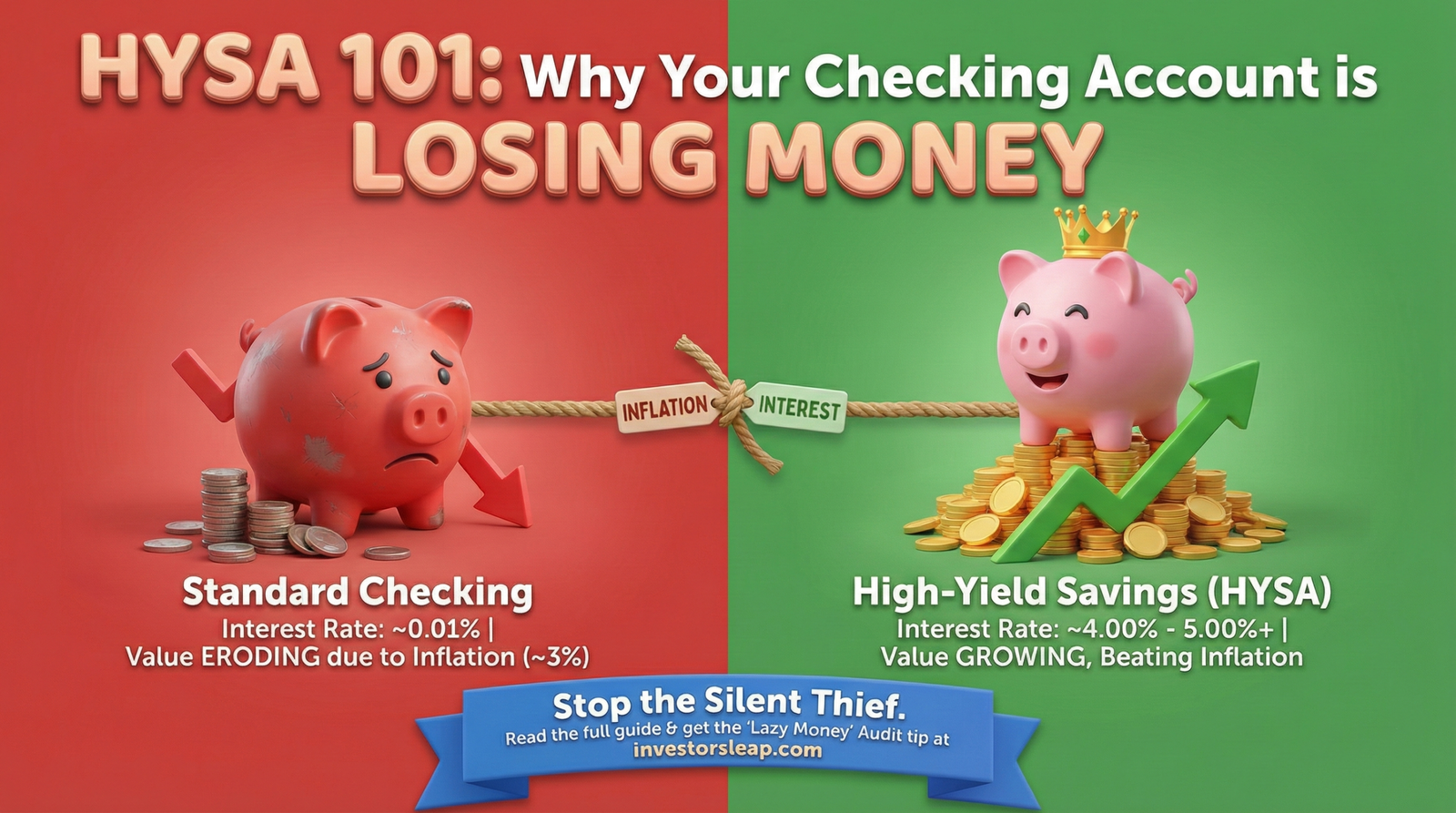
If your cash is sitting in a low-interest checking or savings account, it may be losing purchasing power even while the balance stays the same.
That is the basic problem a high-yield savings account (HYSA) is designed to solve. An HYSA keeps your money liquid while paying a higher annual percentage yield (APY) than many traditional deposit accounts.
For emergency funds, near-term goals, and cash you are not ready to invest, an HYSA can be one of the simplest ways to make idle money work harder without taking stock-market risk.
What Is a High-Yield Savings Account?
A high-yield savings account is a savings account that generally pays a more competitive APY than a typical savings or checking account. Many are offered by online banks or financial institutions with lower overhead costs.
The important word is yield. The higher the APY, the more interest your cash can earn over time. Rates change frequently, so the best account today may not be the best account six months from now.
Why Leaving Too Much Cash in Checking Can Cost You
Inflation gradually reduces what a dollar can buy. If your cash earns less than the rate at which prices rise, your real purchasing power declines.
This does not mean checking accounts are bad. They are useful for bills, debit-card purchases, and immediate cash needs. The problem is using checking as long-term storage for money that does not need to be immediately available.
For a deeper explanation of purchasing-power erosion, read Inflation Is the Silent Killer of Savings.
What an HYSA Is Best Used For
- Emergency funds: cash reserved for job loss, repairs, medical costs, or other unexpected expenses.
- Short-term goals: vacations, a vehicle purchase, home repairs, or a future down payment.
- Cash waiting for a purpose: money you expect to use within a few years and do not want exposed to stock-market volatility.
If you are still building your safety net, start with our Ultimate Emergency Fund Guide.
How Much Can a Higher APY Matter?
The difference between a very low deposit rate and a competitive HYSA becomes more meaningful as your balance and holding period grow.
Instead of relying on a fixed APY example that can become outdated, use the Investors Leap Compound Interest Calculator to test your own balance, APY, and time horizon.
For example, compare what happens when the same cash balance earns 0.10%, 3.00%, 4.00%, or whatever APY is available when you are shopping. That makes the comparison useful even as market rates change.
What to Compare Before Opening an HYSA
| Feature | What to Look For |
|---|---|
| APY | Compare the current annual percentage yield and whether it applies to your full balance. |
| Monthly fees | Prefer accounts without maintenance fees that can erase part of your interest. |
| Minimum balance | Check whether a minimum deposit or balance is required to earn the advertised APY. |
| Deposit insurance | Verify FDIC coverage for banks or NCUA coverage for credit unions, subject to applicable limits and ownership rules. |
| Transfer speed | Know how quickly you can move money to and from your checking account. |
| Access | Review ATM access, mobile deposit, transfer limits, and withdrawal options. |
| Rate conditions | Look for promotional rates, balance tiers, or requirements that could change your actual return. |
HYSA vs. Checking vs. CDs
| Account Type | Best For | Access | Return Potential |
|---|---|---|---|
| Checking | Bills and daily spending | Immediate | Usually low |
| HYSA | Emergency funds and short-term savings | High liquidity | Typically higher than ordinary savings |
| CD | Cash you can leave untouched for a set term | Restricted until maturity | Fixed or predictable for the term |
If you can leave part of your savings untouched for a defined period, compare an HYSA with Chase’s guide to building a CD ladder.
Common HYSA Questions
Is an HYSA safe?
An HYSA can be a low-risk place for cash when the account is held at an appropriately insured financial institution. Always verify the institution and understand how deposit-insurance limits apply to your account ownership.
Is my money locked up?
Usually no. Unlike a traditional CD, savings-account funds are generally accessible, although transfer times, withdrawal policies, and account-specific restrictions can vary.
Can the APY change?
Yes. HYSA rates are generally variable. Banks can raise or lower their APYs as interest-rate conditions and business decisions change.
Should I keep all of my cash in an HYSA?
Not necessarily. Keep enough in checking for near-term bills and normal spending. Cash that is not needed immediately may be better positioned in an HYSA, CD, or another vehicle that matches your time horizon and risk tolerance.
The Investors Leap HYSA Checklist
- Compare APY, not just promotional language.
- Confirm monthly fees and minimum-balance requirements.
- Verify deposit-insurance eligibility.
- Check transfer speed and withdrawal access.
- Read the account terms before moving a large balance.
- Recheck your rate periodically; loyalty to a low-paying account can be expensive.
The Bottom Line
A high-yield savings account will not replace long-term investing, but it can improve the return on money that needs to remain safe and accessible. For emergency reserves and short-term goals, the objective is not maximum growth. It is finding a sensible balance between liquidity, safety, and yield.
Next step: compare current HYSA terms, then use the HYSA Interest Calculator to model your own balance. For the bigger picture, visit the Cash Management & Brokerage guide to see how HYSAs, emergency funds, CDs, and investing can work together.
Investors Leap provides financial education for general informational purposes. This article is not individualized investment, banking, tax, or legal advice. Rates, account terms, and insurance coverage can change; verify current information directly with the financial institution before opening an account.