
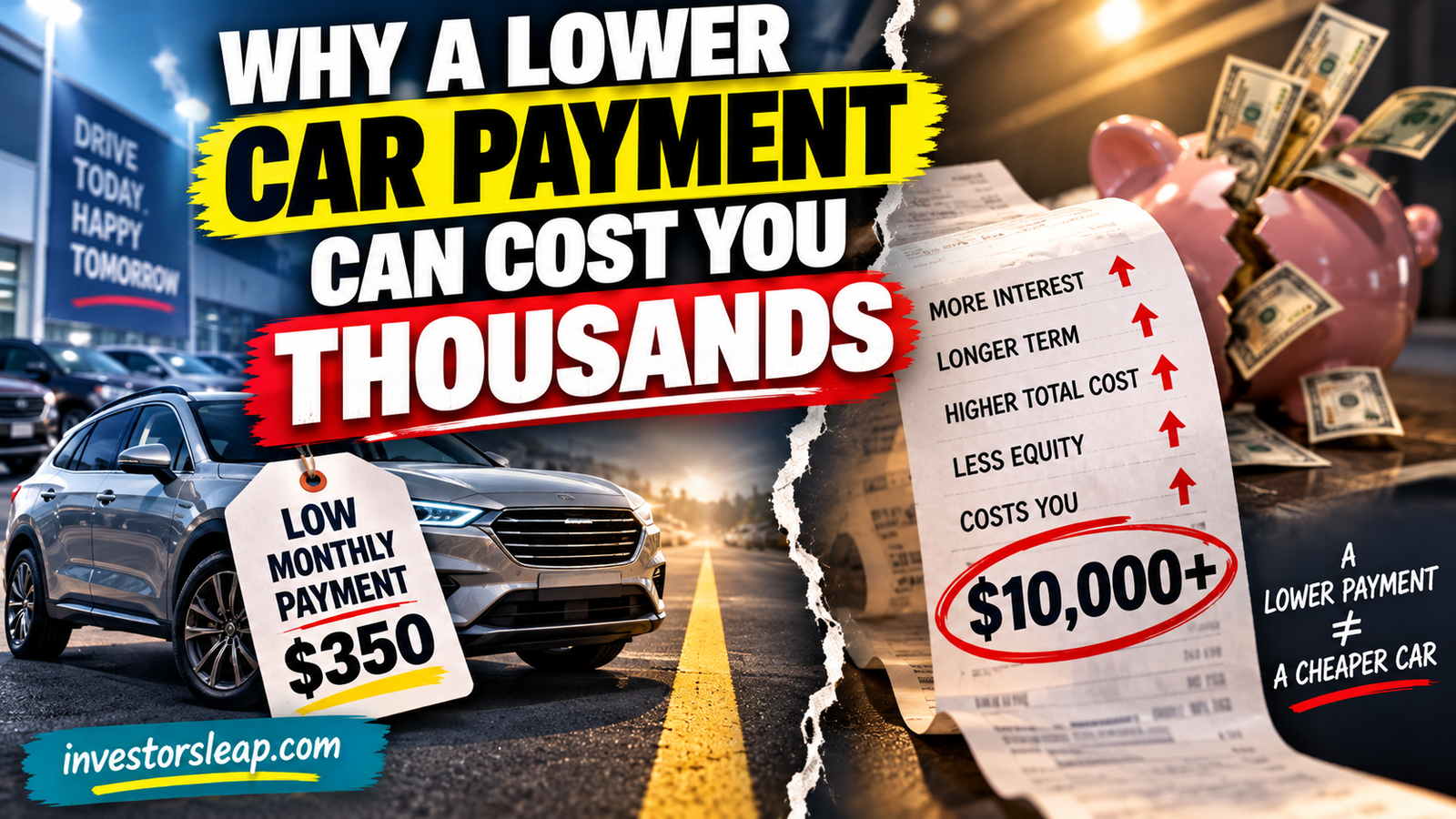

You ask for a lower car payment. The next offer comes back about $206 a month cheaper. Same car. Same amount borrowed. That sounds like a win until you notice that the loan now lasts two more years.
In the example below, that smaller payment adds about $2,717 in interest. Nothing mysterious happened. You simply bought more time to repay the same debt.
A manageable payment matters. There is no prize for choosing a short loan that leaves you unable to cover groceries or rent. But there is a difference between making a payment smaller and making a purchase less expensive.
This week’s $ave It: Pocket-to-Profit challenge is to spot that difference, compare the numbers, and give any genuine savings a job.
The $206-a-month difference that costs $2,717
Imagine financing $30,000 at a fixed 8% annual interest rate, with no loan fees. The rate is an illustration not a current market average or an offer. You make every scheduled payment on time and make no extra payments.
| Loan term | Monthly payment | Total interest |
|---|---|---|
| 48 months | $732.39 | $5,154.61 |
| 60 months | $608.29 | $6,497.51 |
| 72 months | $526.00 | $7,871.80 |
| 84 months | $467.59 | $9,277.26 |
Moving from 48 to 72 months reduces the required payment by $206.39. But total interest increases by $2,717.19, and you keep making payments for another 24 months.
The 84-month option lowers the payment further. Its total interest is about $4,123 more than the 48-month option. All four offers finance the same $30,000.
The Consumer Financial Protection Bureau explains why borrowers should compare loan amounts, rates, terms, and payments together, rather than treating the smallest payment as the cheapest offer.
The takeaway: a lower required payment can create breathing room. When it comes only from extending an interest-bearing loan, that breathing room has a price.
Ask what made the payment smaller
A smaller payment is not automatically a warning sign. The important question is what changed.
A lower purchase price can reduce the amount you borrow. A lower interest rate can reduce borrowing costs when the balance and term stay the same. A longer term spreads repayment over more months. A larger down payment can also lower the loan payment, but it uses cash you already have; it is not the same as negotiating a discount.
Real offers may change several of these at once. A lower rate paired with a much longer term still deserves a full comparison. For a genuine zero-interest loan with no added financing costs, extending the term would not create the interest increase shown in our example.
Do not compare an attractive monthly number from one offer with an incomplete description of another. Put both sets of terms side by side.
Before you sign: compare the whole deal
Ask for the amount financed, interest rate and APR, number of payments, and total scheduled payments in writing. APR includes certain financing charges, so it can differ from the stated interest rate. The CFPB’s auto-loan definitions explain that distinction.
For an existing loan, also request a current payoff quote. Do not assume the balance on your last statement is the exact amount needed to close the loan today.
Then test the payment against your actual household budget. Include insurance, fuel, maintenance, repairs, and registration not just the loan. These are part of the ownership costs the CFPB recommends considering.
A useful sentence for the conversation is: “Please show me the total amount financed and total payments, not only the monthly payment. What changes if we keep the same repayment term?”
That question makes the comparison clearer without committing you to an unaffordable payment.
The immediate fix: lower the cost before stretching the term
Before financing a purchase, compare a less expensive vehicle that still meets your transportation needs. Request an itemized price and review any optional products individually. Decide whether each product is useful to you before discussing how little it adds to the monthly payment.
The CFPB’s negotiation guide explains that optional add-ons increase the amount borrowed when financed and that their prices may be negotiable. An optional product is not automatically worthless, but it should earn its place in the purchase.
In our 72-month, 8% example, financing an extra $3,000 adds about $52.60 a month. Across the full term, that becomes approximately $3,787 in additional payments. The product did not become inexpensive because its cost was presented monthly.
Request competing financing quotes for the same amount and term. Then compare those offers with any dealer financing. A payment target is useful for budgeting; it should not replace the price comparison.
Already have the loan? Start here instead
You do not need to replace your car to review its financing. Start with the remaining balance, remaining payments, interest rate, contract, and available room in your budget.
Compare refinancing from today forward
Compare what remains to be paid on the current loan with all payments and applicable fees on the proposed loan. Include any costs paid upfront; avoid counting a financed fee twice. Interest you already paid on the old loan is not a future saving.
Ask for a quote with roughly the same remaining term before considering a longer one. A lower required payment may still be valuable during a difficult period, but label it accurately: cash-flow relief is not necessarily a reduction in total cost.
Check the rules before paying extra
The CFPB explains that payments generally cover fees and interest before principal. Ask your servicer how to apply additional money toward principal, and verify the next statement.
Also check for a prepayment penalty. Your contract and applicable state law matter; refinancing pays off the original loan, so that check matters for refinancing too.
For illustration, adding $100 every month from the first payment to our $30,000, 72-month loan would pay it off in about 58 months and save approximately $1,608 in interest. That assumes our monthly-interest model, no penalties or fees, and prompt application of payments. Starting extra payments later produces different results.
Do not use money needed for essential bills or an emergency cushion just to match this example. A sustainable plan matters more than an impressive target.
Do not treat a trade-in as a debt reset
Check the vehicle’s value against the payoff amount before trading. Owing more than the vehicle is worth is called negative equity. Rolling that shortfall into another loan adds old debt to the next purchase, as the CFPB cautions. A replacement car with a smaller payment does not automatically solve that problem.
What genuine savings could look like
Suppose a lower-cost purchase lets you borrow $27,000 instead of $30,000, with the same down payment, fixed 8% interest rate, and 60-month term.
The modeled payment falls from $608.29 to $547.46. That is approximately $60.83 a month, or $730 a year, without adding months to the loan.
Over the full term, total loan payments fall by about $3,650: $3,000 less principal and roughly $650 less interest. Unlike the longer-term example, this change reduces both the required payment and the total amount repaid.
This is an illustration, not a promise that every shopper can find an equivalent vehicle for $3,000 less. Compare reliability, condition, insurance, and likely repair needs as well as the purchase price.
Pocket-to-Profit: give the difference a destination
Once a saving is real, decide where it goes before it disappears into other spending.
For someone short on emergency cash, that could mean directing the monthly difference into a reserve. With a stable cash cushion, it might support a plan to reduce expensive debt. Longer-term investing is another possibility once near-term needs are covered—not a guaranteed way to beat loan interest.
Use the free Monthly Budget & Savings Rate Calculator to test what your household can afford. The free Emergency Fund Calculator can help you estimate a cash-reserve target. These tools support budgeting and savings planning; they are not auto-loan payoff quotes.
Need room in the budget before tackling the loan? Start with 5 Bills You Can Lower in One Afternoon, then redirect any verified savings toward your chosen goal.
The question to ask before your next signature
“Can I afford this payment?” is necessary. It is not the only question.
Also ask: “What am I paying in total, how long will I owe it, and what changed to make this payment smaller?”
A cheaper payment can be useful. A cheaper purchase is something different. Knowing which one you are getting is the leap.
Calculation methodology: Investors Leap calculated these original examples using a standard fixed-payment amortization model: monthly payment = P × r ÷ [1 − (1 + r)−n], where P is the amount financed, r is the annual interest rate divided by 12, and n is the number of monthly payments. Total interest equals total modeled payments minus principal. Figures use unrounded calculations and are rounded for display, so multiplying displayed payments may produce small differences. The extra-payment example includes a smaller final payment. All examples exclude loan fees and penalties; actual contracts, interest calculations, payment timing, and rounding can change results. Rates are hypothetical, not current quotes.
Educational disclosure: This article provides general financial education, not individualized financial, legal, or investment advice. Review your own contract and circumstances before changing a loan or using savings to repay debt. Sources were checked October 9, 2026.