
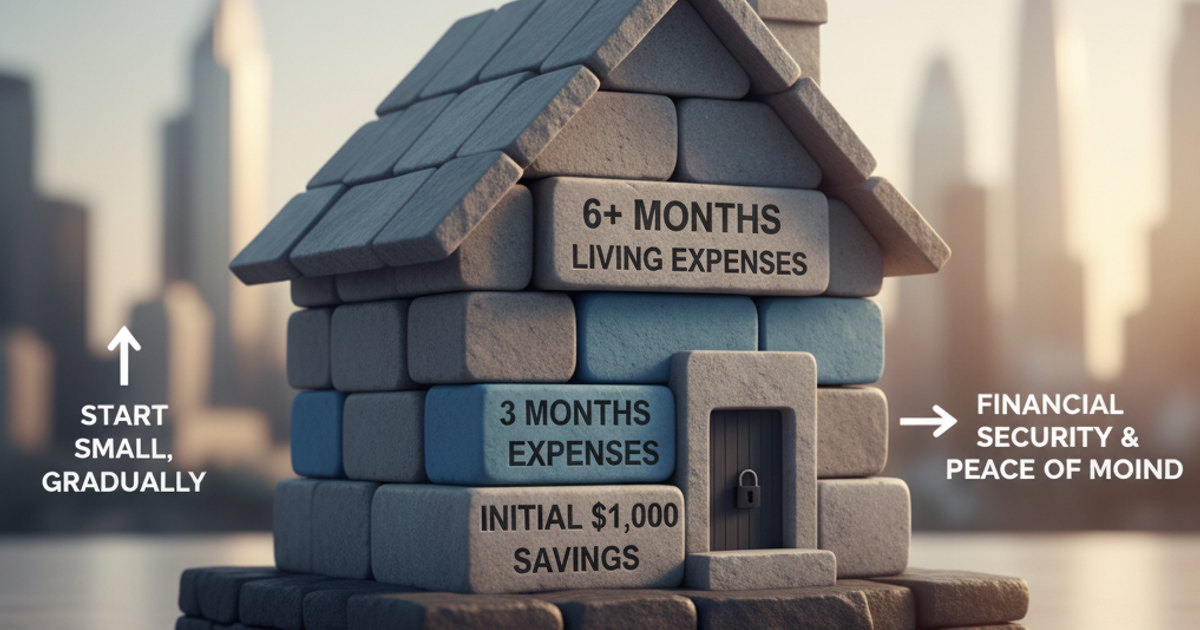
A $500 emergency fund will not solve every financial problem. But it can change what happens when the next small surprise arrives.
A flat tire, urgent home repair, insurance deductible, prescription, or unexpected travel expense can feel very different when you have some cash set aside instead of reaching immediately for a credit card.
That is the idea behind the $500 Emergency Fund Challenge: build a starter cash cushion that is realistic enough to begin now, large enough to matter, and simple enough to finish.
The Consumer Financial Protection Bureau describes an emergency fund as cash specifically reserved for unplanned expenses and notes that the right amount depends on your own situation. It also emphasizes that even small amounts of dedicated savings can help people recover from financial shocks more quickly. CFPB emergency-fund guidance.
Important: $500 is a starter milestone, not a universal recommendation or a complete emergency fund. Once you reach it, use the Investors Leap Emergency Fund Calculator to estimate a fuller target based on your essential monthly expenses.
Watch: The 5-Step $500 Emergency Fund Plan
Watch the Investors Leap video, then follow the challenge below to start building your emergency fund.
Why Start With $500?
Big savings goals can become abstract. If someone tells you that you eventually need several months of expenses, the number may feel so large that you postpone starting.
A first $500 creates a concrete finish line. It can cover or soften many smaller emergencies, and just as important, it helps build the habit of keeping money available for problems you did not schedule.
The goal is not perfection. The goal is to create distance between an unexpected bill and expensive debt.
If you already have $500 set aside, you can still use this challenge. Make $500 your next milestone and continue building toward the amount that fits your household.
Choose Your $500 Timeline
There is no prize for finishing fastest. Pick a pace that does not create another problem in your budget.
| Timeline | Amount to Save |
|---|---|
| 4 weeks | $125 per week |
| 8 weeks | $62.50 per week |
| 10 weeks | $50 per week |
| 20 weeks | $25 per week |
If your income varies, skip the rigid weekly target. Instead, choose a rule such as 10% of every paycheck, tip, side-gig payment, or windfall until the balance reaches $500. The point is consistency, not forcing an amount that does not fit.
Step 1: Create a Separate Home for the Money
Do not leave your emergency money mixed into the checking-account balance you use for everyday spending. A separate savings account makes the purpose clearer and reduces the temptation to treat the money as available for routine purchases.
Look for an account that is safe, easy to access when genuinely needed, and does not charge fees that undermine the balance. If you are comparing high-yield savings accounts, read HYSA 101 and use the HYSA Interest Calculator to model your own balance and APY.
For bank deposits, verify that the institution is FDIC-insured. The FDIC states that savings accounts at insured banks are covered subject to applicable limits and ownership rules; the standard insurance amount is currently $250,000 per depositor, per insured bank, for each ownership category. FDIC deposit-insurance information.
Step 2: Find the First $50 Without Rebuilding Your Entire Life
Your first move should be small and immediate. Find $50 that can move into the account within the next seven days.
That may come from canceling one unused subscription, eating from the groceries already in the house for a few days, selling an item you no longer use, skipping one convenience purchase, redirecting part of a cash-back reward, or moving a small amount from your next paycheck.
If you want a structured expense audit, use Need $200 This Month? Start With These 7 Expenses. You do not need to cut all seven. One or two may be enough to fund the first part of this challenge.
Step 3: Automate the Next Deposit
Once the first transfer is made, schedule the next one before motivation has a chance to fade.
The CFPB specifically identifies recurring bank transfers and split direct deposit as practical ways to make saving more consistent. Automation works because it turns the decision from something you must remember every week into a system.
If $25 per week works, automate $25. If $10 works, automate $10. You can always add more manually when you have extra cash.
Step 4: Use a Simple Three-Bucket Rule for Extra Money
Whenever unexpected money arrives, decide in advance how much goes to the challenge. A simple approach is:
- 50% to your $500 emergency fund until the starter goal is reached.
- 30% to another current priority, such as debt payoff or a planned bill.
- 20% for yourself so the plan does not feel like punishment.
You can change the percentages. What matters is having a rule before the money lands in your account.
Step 5: Decide What Counts as an Emergency Before One Happens
An emergency fund works better when you define its job ahead of time.
Good examples include an urgent car repair you need to get to work, a necessary home repair, an unexpected medical expense, a sudden loss of income, or emergency travel for a serious family situation.
Concert tickets, holiday shopping, a routine annual insurance premium, a planned vacation, and a phone upgrade are not emergencies simply because the bill feels inconvenient. Those expenses deserve separate sinking funds.
Write down your own rules. That makes it easier to protect the $500 when a tempting non-emergency appears.
What If You Have to Use the Money Before You Reach $500?
Use it if the expense fits the rules you created. That is the purpose of the fund.
Then restart the challenge from the new balance. Using emergency savings for a legitimate emergency is not failure. It means the cushion performed its job.
What Happens After You Reach $500?
Celebrate the milestone, then keep going.
Your next target should be based on your actual household rather than a generic number. Add up your essential monthly expenses and think about how stable your income is, whether your household relies on one income or several, your insurance deductibles, dependents, health needs, and the types of unexpected expenses you have faced before.
Use the Emergency Fund Calculator to estimate a larger reserve. Then read the Ultimate Emergency Fund Guide for the broader strategy.
For help deciding how emergency savings, short-term cash, CDs, and investing fit together, visit the Cash Management & Brokerage guide. For more foundational saving strategies, explore the Saving 101 hub.
Your $500 Challenge Checklist
- Open or designate a separate savings account.
- Choose your timeline.
- Move the first $50.
- Automate the next transfer.
- Redirect part of windfalls and extra income.
- Write down what qualifies as an emergency.
- Track the balance until you reach $500.
- After $500, calculate your longer-term emergency-fund target.
The Bottom Line
A strong financial foundation is rarely built with one dramatic move. It is built when small decisions become systems.
Your first $500 will not cover every emergency, and it should not be treated as the finish line. But it can be the point where you stop starting from zero every time life gets expensive.
Start with the first transfer. The challenge becomes real the moment the money moves.
Investors Leap provides financial education for general informational purposes. This article is not individualized financial, investment, banking, tax, or legal advice. Savings needs and appropriate account choices vary by household. Verify current account terms and deposit-insurance coverage before opening or funding an account.